Cactus Succulents Jumbo Paperclip PNG
A Designer’s First Look: Playful, Bold, and Unexpectedly Versatile
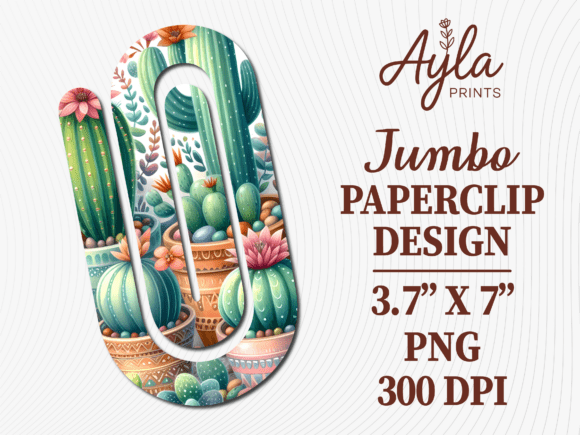
When I opened Cactus Succulents Jumbo Paperclip PNG, my first thought wasn’t “Oh, another cactus motif”—it was “This is a paperclip *with personality*.” The design leans into cheerful irony: a chunky, friendly jumbo paperclip holding a cluster of stylized succulents—plump echeverias, spiky agaves, and soft sedums—all rendered with clean outlines and balanced negative space. It feels modern but warm, minimalist but full of life. At roughly 3.7×7 inches, it’s not dainty—it’s statement-sized. That immediately tells me this isn’t for subtle monograms or tiny collar accents. It’s for projects where charm meets presence: a canvas tote bag for a plant shop, the front chest of a relaxed-fit sweatshirt, or the center panel of a linen kitchen towel.
How It Holds Up in Real Embroidery Projects
I tested Cactus Succulents Jumbo Paperclip PNG as part of a small-batch run for a local boutique—custom embroidered cotton tote bags meant for weekend farmers’ market shoppers. The design translated beautifully to machine embroidery when digitized carefully: the paperclip’s curved body became a smooth satin stitch band, while the succulents broke down cleanly into layered fill stitches and subtle running-stitch texture. Because the original PNG has crisp edges and moderate detail—not overly intricate, not cartoonishly simple—it gave our digitizer room to optimize stitch density without losing character.
It shines on medium-weight fabrics: sturdy cotton twill for aprons, midweight fleece for baby blankets, and brushed poly-cotton blends for sweatshirts. On those surfaces, the shape reads clearly, the succulents retain their individuality, and the paperclip’s “clip” action feels intentional—not stiff, not sloppy. As an embroidered patch? Excellent. The proportions support clean edge finishing, and the vertical orientation makes it ideal for sleeve placement or back-neck accents on caps (though cap curvature means you’ll want to test hoop placement first).
Where to Use It Thoughtfully
- Small hoop sizes: Avoid hoops under 5×7 inches—the design’s height demands breathing room. You’ll lose definition in the succulent details or force awkward scaling.
- Textured or stretchy fabrics: On terry cloth towels or jersey knits, stabilize generously. The paperclip’s long curve can pucker if tension isn’t balanced.
- Dark or dense fabrics: This design relies on contrast. On charcoal or navy, choose thread colors that lift—not match. A pale sage or creamy white thread keeps the succulents legible; avoid black-on-black unless you’re aiming for high-fashion subtlety (and even then, test first).
- Frequent-wash items: For baby onesies or kids’ tea towels, confirm your digitizer uses appropriate underlay and lock stitches at junctions—especially where the paperclip “bends” around the plants. That joint is a stress point.
What It Adds to Your Handmade Product—and What It Doesn’t Promise
Cactus Succulents Jumbo Paperclip PNG doesn’t pretend to be botanical-accurate or ultra-detailed. And that’s its strength. It delivers instant recognition, approachable charm, and craft-friendly scalability. Customers respond to its wit—especially in niches like plant lovers, eco-conscious shoppers, or teachers who love classroom-themed gifts. I’ve seen it elevate Etsy listings for personalized nursery decor: paired with a soft gray muslin pillow cover, it reads as intentional, curated, and handmade—not mass-produced.
But let’s be clear: it won’t replace a finely digitized appliqué design for heirloom baby quilts, nor does it carry built-in metallic or variegated thread effects. It’s a graphics asset—not an embroidery file—so your digitizer (or your own software) must translate it properly. That means stitch density, pull compensation, and underlay strategy are still *your* call. Used well, it boosts perceived value and brand consistency. Used hastily, it risks looking flat or misproportioned—especially if scaled beyond its natural range.
Practical Notes Every Embroidery Designer Should Run Through
- Test on scrap fabric *first*—same weight and weave as your final project.
- Check thread color contrast on both light and dark backgrounds using printable mockups before stitching.
- Review stitch density in the succulent centers: too dense = stiff fabric; too sparse = lost detail.
- Confirm hoop size compatibility—this design needs space to breathe vertically.
- Inspect small corners (like the paperclip’s inner curve) for stitch buildup—adjust stop points if needed.
- Use cutaway or tear-away stabilizer based on fabric stretch and end use—no exceptions for baby items or frequent-wash goods.
- Verify licensing terms before selling finished products or bundling digitally—Cactus Succulents Jumbo Paperclip PNG is a Graphics product, so commercial use rights depend on the seller’s policy.
Final Thought: A Design That Starts Conversations
This isn’t just a cactus. It’s a paperclip holding joy. That slight absurdity—functional office supply meets desert garden—is why it works so well in real craft business settings. It fits seamlessly into spring collections, teacher appreciation bundles, wedding favor totes, or even small-shop branding (think: embroidered tags or packaging accents). For Etsy sellers and handmade shop owners, it’s a low-risk, high-charm addition to your design assets—provided you treat it like the thoughtful starting point it is, not a plug-and-play embroidery file. Digitize with intention, stitch with care, and let the personality shine through. That’s how Cactus Succulents Jumbo Paperclip PNG earns its place—not as background filler, but as a quiet signature on something truly made by hand.